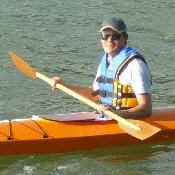
The kayak doesn't really have a name. I have jokingly referred to it as 'Bullseye' and the double that is to come as 'Double Top' in reference to the design name of Dart and the cult but awful British darts quiz show. I don't think kayaks are boat enough to bare a name though, but that's not the case with subsequent builds.
Currently I have half-hatched plans for a 16' 3-ply sheet proa. I've got a model made that proves the shapes I have designed end up looking like a boat of sorts, I've just the rigging to add. Because I intend to make this boat for very little money, most of the materials will be sourced from large DIY outlets, and so I thought the name 'Big Shed' appropriate. I'd like to have this in Maori, or even better, what ever the native tongue of the Marshall Islands is, but I'll have to be careful to get a good translation and not rely on Internet tools of questionable validity.
Since starting the model, I've been thinking about the difficulties of shunting the real thing (changing the end of the main hull at which the sail is tacked and changing the direction of travel while keeping the outrigger to windward). One solution is to go for a sail with no lower spar and the upper spar hoisted from its mid-point. Such a rig is tipped from one end to the other and is called a Gibbon's Rig. I think it would suit a smaller, single-handed proa and would have to be called the 'Funky Gibbon'. I think it would have a large silhouette of a brachiating gibbon painted on the polytarp sail just for good measure.
These are side projects. I really want to get going on making a dinghy over the winter so I can learn to sail in my own boat. I've decided on another Selway-Fisher design, the Rhum. It will be light enough to trolley down to the beach, can take a small outboard for a spot of fishing and can be rigged with a Gunter rig, similar to the UK Mirror dinghies. It will need a name and I've been thinking along musical themes. I've been looking through song names by my favourite bands to some up with something less in jest than the proa names. Likely candidates are 'Hope', 'Spindrift', 'Red Barchetta' (but only if I paint it red, which is unlikely because its a notoriously difficult colour), 'Working at Perfekt', 'Born of Frustration', 'Anthem', 'Earthshine', 'Beautiful Machine' and 'Pacifier'.
'Pacifier' is likely to be reserved for a bigger boat, should I not like the name it comes with. I like the idea of its relation to Pacific, as in the ocean and the calming affect that messing about in boats tends to have. Rather than building a camp-cruising boat, I'm on the lookout for a good trailer-sailer with sleep-aboard accommodation for 4. This needs a bit of preparation work, firstly I need to learn more about sailing (hence the dinghy build) and secondly, I need to prepare a space on the driveway; more landscaping work.
Showing posts with label boats. Show all posts
Showing posts with label boats. Show all posts
Thursday, April 2, 2009
Thursday, February 19, 2009
Off my Trolley
The kayak trolley has been providing me with lots of headaches, and the kayak with lots of scratches.

The Mk I version was hopeless, so I angled the bunks a bit to provide the Mk II, which also shed its load on the way to the beach. The photo shows the more elaborate Mk III with wide, raised bunks set further forward on the boat to help with balance, and the bungee cords replaced by nylon cam-lock straps. This also failed while taking the kayak down for a quick paddle out to 'VESPER', a schooner moored about 1 km away and which I originally suspected to be a remnant of New Zealand's fleet of trading scows. I know now that it's not a true scow, but need to research a little more to see if there is any link at all to the scows of old. Either way, I ended up carrying the kayak back, along with the trolley and was nearly late for a night out as a result.
The Mk IV trolley is sitting in the garage waiting to be tested, but as I write the rain is torrential and a gale warning is in force, so it will have to wait in the garage a little longer.
My building and boating activities have been somewhat curtailed of late. For the last 4 weeks I've been acting as full time tour guide to my parents, over on a visit from the UK. I did manage to get away yesterday evening however, to take part in a race on board my friend and neighbour's Beale 33' cruiser/racer. Winds were up 15 - 20 knots and with only two of us on board, it was quite exciting. We didn't do well, but that was mainly down to confusion at the start when the skipper accidentally reset his stop watch and so we had only the 1 minute gun to go by, crossing the start over 30 seconds late. I learned a lot during the race though, and also managed to use some of what I've read over the past few months, all good practice for when I build my own boat.

Wednesday, February 4, 2009
Saltier by the Day
I think I'm turning into an antipodean Gavin Atkin. For those few of you who read these pages and don't know who Gavin is, then I suggest you get over to intheboatshed.net immediately.
I must admit that I like the idea of not only building my own boat, but also designing its lines. And through reading Gavin's blog, I've developed a respect and increasing interest in older boats and ships.
While I was paddling round the upper Waitemata Harbour at the weekend, I was fascinated by the many boats I saw moored up along the way. One of these I suspected to be a converted sailing scow, a commercial vessel from 100 years ago, essential in the development of Auckland as a city.
Today I went with my parents to the National Maritime Museum. We took a look at the racing boats and sponsor's yachts and launches, here in town for the Louis Vuitton Pacific Series and then headed for the museum. They wanted to potter around and enjoy the waterfront, but I was on a mission.
I took lots of notes and photographs of the exhibits in the Hawaiki hall, especially of this Kiribati canoe. It is a proa, that is it does not tack but shunts, the outrigger stays to windward and the lower point of the sail is moved to the other end of the boat and it 'reverses'. This is in fact a western prejudiced way to think of it, for in this type of boat the axis of symmetry is shifted 90 degrees and there is no front or back, but a windward and leeward. Anyway, I want to build one so I thought I'd examine an original rather than use plans of a western interpretation.

I also wanted to check out the Ted Ashby, one of the few remaining sailing scows still working for a living, albeit as a harbour cruise distraction for the paying visitors to the museum.

Between the Pacific craft in the Hawaiki hall and the quay where the Ted Ashby and other vessels are moored, I came across this beautiful rowing boat. It spent its working life in the Auckland Islands, 300 km south of the main New Zealand land masses. It appears to never have been used though. It was stationed on the islands along with cashes of food and clothes in case of ship wrecks.

I intend to deliver more on each of these vessels. I'll digest my notes and try and define the critical forms, structures and mechanisms of the sailing canoe, determine whether the boat I sighted was indeed an original scow (with the help of a volunteer and model maker at the museum) and publish more photographs and details of the boat and the castaway station on the Auckland Islands.
I must admit that I like the idea of not only building my own boat, but also designing its lines. And through reading Gavin's blog, I've developed a respect and increasing interest in older boats and ships.
While I was paddling round the upper Waitemata Harbour at the weekend, I was fascinated by the many boats I saw moored up along the way. One of these I suspected to be a converted sailing scow, a commercial vessel from 100 years ago, essential in the development of Auckland as a city.
Today I went with my parents to the National Maritime Museum. We took a look at the racing boats and sponsor's yachts and launches, here in town for the Louis Vuitton Pacific Series and then headed for the museum. They wanted to potter around and enjoy the waterfront, but I was on a mission.
I took lots of notes and photographs of the exhibits in the Hawaiki hall, especially of this Kiribati canoe. It is a proa, that is it does not tack but shunts, the outrigger stays to windward and the lower point of the sail is moved to the other end of the boat and it 'reverses'. This is in fact a western prejudiced way to think of it, for in this type of boat the axis of symmetry is shifted 90 degrees and there is no front or back, but a windward and leeward. Anyway, I want to build one so I thought I'd examine an original rather than use plans of a western interpretation.

I also wanted to check out the Ted Ashby, one of the few remaining sailing scows still working for a living, albeit as a harbour cruise distraction for the paying visitors to the museum.

Between the Pacific craft in the Hawaiki hall and the quay where the Ted Ashby and other vessels are moored, I came across this beautiful rowing boat. It spent its working life in the Auckland Islands, 300 km south of the main New Zealand land masses. It appears to never have been used though. It was stationed on the islands along with cashes of food and clothes in case of ship wrecks.

I intend to deliver more on each of these vessels. I'll digest my notes and try and define the critical forms, structures and mechanisms of the sailing canoe, determine whether the boat I sighted was indeed an original scow (with the help of a volunteer and model maker at the museum) and publish more photographs and details of the boat and the castaway station on the Auckland Islands.
Subscribe to:
Posts (Atom)