Thursday, February 19, 2009

Off my Trolley

The kayak trolley has been providing me with lots of headaches, and the kayak with lots of scratches.

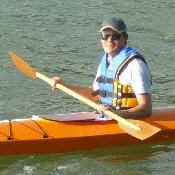
The Mk I version was hopeless, so I angled the bunks a bit to provide the Mk II, which also shed its load on the way to the beach.  The photo shows the more elaborate Mk III with wide, raised bunks set further forward on the boat to help with balance, and the bungee cords replaced by nylon cam-lock straps.  This also failed while taking the kayak down for a quick paddle out to 'VESPER', a schooner moored about 1 km away and which I originally suspected to be a remnant of New Zealand's fleet of trading scows.  I know now that it's not a true scow, but need to research a little more to see if there is any link at all to the scows of old.  Either way, I ended up carrying the kayak back, along with the trolley and was nearly late for a night out as a result.

The Mk IV trolley is sitting in the garage waiting to be tested, but as I write the rain is torrential and a gale warning is in force, so it will have to wait in the garage a little longer.

My building and boating activities have been somewhat curtailed of late.  For the last 4 weeks I've been acting as full time tour guide to my parents, over on a visit from the UK.  I did manage to get away yesterday evening however, to take part in a race on board my friend and neighbour's Beale 33' cruiser/racer.  Winds were up 15 - 20 knots and with only two of us on board, it was quite exciting.  We didn't do well, but that was mainly down to confusion at the start when the skipper accidentally reset his stop watch and so we had only the 1 minute gun to go by, crossing the start over 30 seconds late.  I learned a lot during the race though, and also managed to use some of what I've read over the past few months, all good practice for when I build my own boat.

Wednesday, February 4, 2009

Saltier by the Day

I think I'm turning into an antipodean Gavin Atkin. For those few of you who read these pages and don't know who Gavin is, then I suggest you get over to intheboatshed.net immediately.

I must admit that I like the idea of not only building my own boat, but also designing its lines. And through reading Gavin's blog, I've developed a respect and increasing interest in older boats and ships.

While I was paddling round the upper Waitemata Harbour at the weekend, I was fascinated by the many boats I saw moored up along the way. One of these I suspected to be a converted sailing scow, a commercial vessel from 100 years ago, essential in the development of Auckland as a city.

Today I went with my parents to the National Maritime Museum. We took a look at the racing boats and sponsor's yachts and launches, here in town for the Louis Vuitton Pacific Series and then headed for the museum. They wanted to potter around and enjoy the waterfront, but I was on a mission.

I took lots of notes and photographs of the exhibits in the Hawaiki hall, especially of this Kiribati canoe. It is a proa, that is it does not tack but shunts, the outrigger stays to windward and the lower point of the sail is moved to the other end of the boat and it 'reverses'. This is in fact a western prejudiced way to think of it, for in this type of boat the axis of symmetry is shifted 90 degrees and there is no front or back, but a windward and leeward. Anyway, I want to build one so I thought I'd examine an original rather than use plans of a western interpretation.

I also wanted to check out the Ted Ashby, one of the few remaining sailing scows still working for a living, albeit as a harbour cruise distraction for the paying visitors to the museum.

Between the Pacific craft in the Hawaiki hall and the quay where the Ted Ashby and other vessels are moored, I came across this beautiful rowing boat. It spent its working life in the Auckland Islands, 300 km south of the main New Zealand land masses. It appears to never have been used though. It was stationed on the islands along with cashes of food and clothes in case of ship wrecks.

I intend to deliver more on each of these vessels. I'll digest my notes and try and define the critical forms, structures and mechanisms of the sailing canoe, determine whether the boat I sighted was indeed an original scow (with the help of a volunteer and model maker at the museum) and publish more photographs and details of the boat and the castaway station on the Auckland Islands.

Sunday, February 1, 2009

More Sea Trials

After the launch I went away for a week to the Coromandel.  While there we (me, my parents, partner and son) went on a sailing excursion that I highly recommend to anyone in the area.

The day after I got back I went out for a quiet paddle.  The boat seemed to be moving well so I continued across the entrance of Island Bay and carried on up the west coast of the North Shore until I got to Beach Haven point.  I then made a bold move across the harbour to the boat ramp used to beach Sunderland and Catalina flying boats at the old Hobsonville airfield.  I then tried to cross diagonally back over before hugging the coast again for the last couple of bays, but the boat was catching so much wind I ended up straight-lining the route to the home beach.

I think I'd like to fit a rudder to help steer the boat while I paddle a steady rhythm.  Instead, I was making 3-4 strokes on one side for each stroke on the other to compensate for the wind.  Towards the end of the trip the sea got quite choppy and a bit of water was coming in, so that spray deck is also looking quite essential.  I've now dismantled part of the trolley.  It needs the bunks to be properly aligned with the angles of the hull, and in future I'll secure it to the kayak with some nylon cam-lock straps instead of bungee cords.

Wednesday, January 21, 2009

Launch

After picking my parents up from the airport, I quickly finished making a trolley for the kayak while they got freshened up. There was a very high tide today at 5:00pm, so at 6:30 there was still plenty of water over the oyster shells for a safe launch after a quick trundle down to the beach.


I went out about 100m, rounded the wharf and paddled into Island Bay (which completely empties on a low tide) and then back again. The boat was very stable but quite a lot of water came over the bow. A spray skirt will be necessary before I cross any rougher water. Also, the paddle could do with being about 200mm longer. I may achieve this by adding an aluminium section to the middle and making it a two-piece paddle.

Completion

Here's a couple of pics of the finished product, sitting on the driveway on Wednesday evening awaiting launch the following day.


Sunday, January 18, 2009

Quick Update

The launch date for the kayak is scheduled for 22nd January, this Thursday afternoon.

My parents arrive for a month long visit from the UK, and I'll launch in the afternoon after I've picked them up from the airport.

The kayak is mostly painted, just some black pinstripes and a couple of areas to be touched up.  The seat is painted, the paddle is varnished and I've made and painted a toggle for the bow line.  Final touches will be some foam rubber mat cable tied to the seat and the forward deck beam (to protect my shins).

I still have top make a trolley to take it the 200m or so to the local boat ramp and beach.  I'll probably end up carrying it because I also have to paint and fit foot grips to some bolt-on sidesteps a friend fabricated for the Land Rover a couple of years ago.

Its going to be tight, but a Thursday launch it is.  

Thursday, January 8, 2009

New Year, Same Kayak

Well, that's Christmas and New Year out of the way.

I was really busy getting ready for Christmas, then we went camping for a few nights and got back on New Year's day. I went back to work the following Monday, so tried to spend the weekend doing fun, family stuff rather than sanding.

I finally got around to sanding the first coat of primer and adding a little knifing putty to some of the less well prepared areas (the ones that only show up once its all the same colour). I did a big session of sanding last night and got it close enough. I'm brush painting the top coats so once the minor scratches and edges in the filler are smaller than a brush mark, I don't see the point in spending any more effort getting it better. I will, however, be asking for a random orbital sander for my birthday.


So this evening I put on a second coat of primer. I'll flat it off with a quick rub of 220 grit paper, with a little more attention being payed to a few inevitable runs and drips. It was around 25 degrees Celsius when I was painting in the early evening, and the water based paint was drying as fast as I could brush it out, keeping a wet edge was nigh on impossible.

In the background, between coats, I've also prepped the seat for top-coating, rubbed the paddle down ready for a final coat of varnish, and spray painted some deck hardware in satin black enamel after etch-priming (its all galvanised steel).